

HOMILY FOR THE TWENTY-FIFTH SUNDAY OF YEAR A
My first encounter with a deathbed conversion was in the beautiful novel, Brideshead Revisited, by Evelyn Waugh. As a young twenty-something I remember being moved to tears at the conversion of Lord Marchmain. For weeks he had been ill and on the point of death, while he and his family wrangled over the things of life, death and God. He had a personal history of sin and unfaithfulness to his wife and family, and stubbornly resisted any talk of repentance, forgiveness, or calling a priest. I literally sobbed on reading that this cantankerous, difficult man, who at the last appeared barely conscious, on being absolved and anointed by the priest, “moved his hand to his forehead, ... then the hand moved slowly down to his breast, then to his shoulder, and [he] made the sign of the cross.”
Why speak of deathbed conversions at all? Because they raise a question: do we see deathbed and late-life converts as scoundrels who cut in at the last minute — at the eleventh hour, to use the language of today’s parable — or do we see who they truly are: remorseful penitents who finally recognise the tragedy of a squandered life that made no room for the love of God? How we answer may reveal who we are represented by in the Gospel parable today.
In 2003, researchers at Emory University in Atlanta ran a well-known experiment with capuchin monkeys, training them to trade a stone for a slice of cucumber. All went well until some monkeys were given a sweet grape instead of cucumber for the very same stone — at which point the cucumber-monkeys revolted, hurling their cucumber back at the researchers in disgust and protest. Headlines called it “Monkeys Strike for Justice” and “Monkeys Have a Sense of Justice.”
We human beings have a keen sense of justice and fair play. Think of small children rushing to grab the fullest glass of juice, checking who has got more than the other, and complaining if they think it unfair. That is, on some level, an image of all of us throughout our lives: given to judging and comparison, to envy, and to claiming what we think is ours by right.
God’s generosity surpasses anything we might come up with.
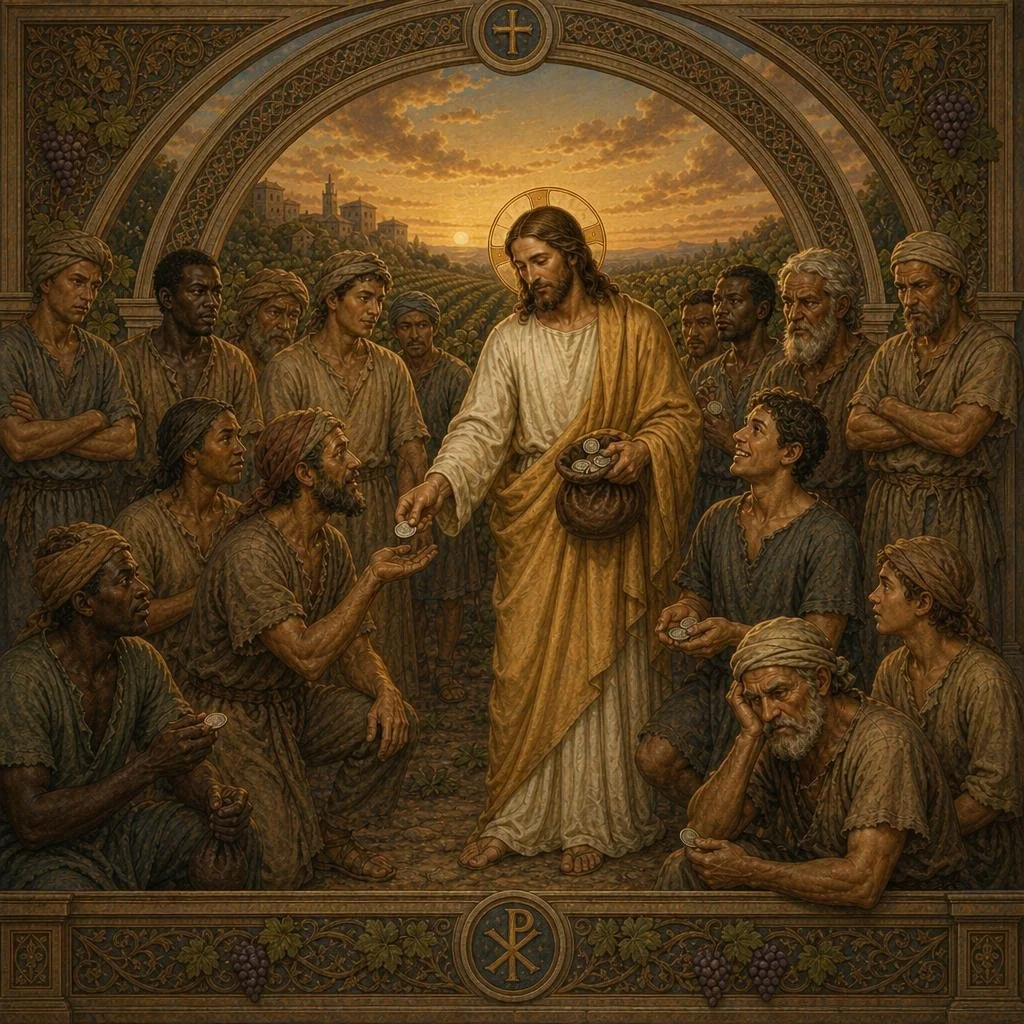
By human standards it is shocking, even scandalous. The parable makes this plain: those who worked a full day, perhaps twelve hours in the hot sun, were paid the same denarius — the standard wage for a day’s labour — as those who worked only one hour in the relative cool of the day. It helps to recall what this parable meant for those who first heard it. Behind the image of labourers hired at different hours of the day lies the whole span of salvation history: Israel, called and labouring in God’s vineyard from the very early morning of the Old Covenant, and the Gentiles, grafted in only at the eleventh hour, with the coming of Christ and the New Covenant. There is no violation of justice here. God is not unfair to Israel; he is simply generous to the late-coming Gentiles, making them, as St Paul writes, equal members of the one people of God (cf. Ephesians 2:11–13). The point in this parable is not strict justice but sheer generosity — and this is very likely also where our own English phrase ‘at the eleventh hour’ comes from. Human justice is more often than not punitive and vengeful, quick to measure out exactly what is deserved and no more. God’s justice, on the other hand, seeks to heal, to restore, to embrace and build up. We see this generosity illustrated in the parable: the landowner had compassion on those workers who were unemployed for the whole day, “… because no one had hired them.” They too had families to support and feed, and had waited all day for employment without success, hoping someone would come. When the landowner finally approached them at the end of the day, he was generous to them — not because they had earned a wage by working hard, but simply out of compassion for people that the day had passed by.
I was profoundly reminded of this some years ago, helping my parents with their garden in Glencairn near Simonstown. Casual labourers could be hired at the four-way stop on the way to Kommetjie. I remember arriving there in my Dad’s bakkie; and as soon as it was clear I was looking for day labourers, around 30 young men ran towards me, begging to be employed. How painful it was to choose only three, even though I had meant to employ just one. When I took them back that evening, there were still many waiting. In the parable, the workers who were hired first grumble like children squabbling over the fair distribution of juice or biscuits. They had been given the wage agreed on, but ignored this and compared it instead with what others were receiving — a good reflection of ordinary human nature at its most inward-looking, selfish, and self-seeking.
These workers are not yet truly part of the Kingdom of God, because they have not grasped the generosity and compassion that should mark our relationships with one another and with God. The indulgent generosity and compassion of the landowner in the Gospel parable gives us a hint of the way God relates to us in this Kingdom of God, and of how we are meant to relate to each other.
To be in the Kingdom of God is to see and love as God loves. The early Christian writer Origen read the parable’s hours in a further, more personal way. For him, each hour of the working day stands for a season of a person’s life in which grace can reach them. Whenever that call comes — in youth, in the middle years, or almost at life’s end — conversion draws a person out of an idle, unfruitful existence and sets them labouring in Christ’s vineyard, with time still to bring in a real harvest before the sun sets on their life. Early or late, what each labourer receives is the same: the generous and equal gift of eternal life.
What about those of us who have perhaps been in the vineyard since the early hours of the morning — that is, for the whole of our lives? A person born Catholic, baptised as an infant, who has received all the sacraments, gains precious little from any of it if they have not fallen in love with Jesus Christ, if they have not become an actual disciple. To be a cradle Catholic without a living faith is simply an immense sadness. Those who have ticked all the boxes, but without entering into a love relationship with the landowner, may presume on their reward and resent eleventh-hour converts receiving the same, or perhaps more.
St Augustine, who came to faith only in his early thirties after years of restless searching, gave voice to this same wonder near the end of his Confessions: “Late have I loved you, O Beauty ever ancient, ever new, late have I loved you!” His late arrival in the vineyard did not diminish God’s welcome and his reward.
The first reading, from the book of Isaiah, tells us that God invites us to seek him, to call on him, and to turn from all that is wrong and destructive in our lives. The motivation for accepting this invitation is overwhelming: we are told that if we seek God, he is to be found; if we call on him, he is near; and if we turn back to him, he will take pity, for he is rich in forgiving, kind and full of compassion, slow to anger, abounding in mercy.
Where love is involved, it is never too late.
Hearing this Gospel, we are invited to come to this beautiful God made known to us in the person of Jesus Christ, and we are meant to become more God-like in our thinking, acting, speaking and praying. God invites us to come to him, to learn from him and be like him.
We are to welcome God’s mercy towards others, even as we hope to receive mercy ourselves.
