

The Emmaus Story
Homily for Third Sunday of Easter, Year A
The opening prayer for this Mass, asking that we may exult forever in renewed youthfulness of spirit, reminds me of an experience some years ago when I was looking after the Hermanus parish — which included Hermanus itself, Zwelihle township, Gansbaai and Bredasdorp. That Lent, I encouraged the parishioners to pray for a special Easter grace, for a remarkable Easter, and I prayed the same for myself — just as I invited each of you, during this past Lent, to pray for your own special Lenten and Easter grace this year.
It was a demanding Triduum covering the four communities in the parish. By the time I got to Zwelihle after midday on Easter Sunday I was exhausted, concerned that the people there were getting the dregs — a tired priest after midday on Easter Sunday. Well, I was met with a welcome fit for a king, and escorted into the church with singing and dancing. They had been there since the previous afternoon, praying and singing through the night, and their rejoicing was undiminished even so late in the Easter day.
When it came to singing the Gloria, the whole congregation, from the smallest children to ninety-year-olds, broke out into a choreographed dance as they sang in Sesotho, ringing bells and using pipes as trumpets. I was overwhelmed. It was a moment of grace, conversion, and renewed commitment which enabled me to make a key decision at that time which still impacts on my ministry today — my special Easter grace, one of the key moments of my life so far.
And so I ask you: What grace would you say you are experiencing this Easter? What has changed for you? Those newly baptised, received into the Church, and confirmed, have their own stories to tell, I assure you.
Walking in the Wrong Direction
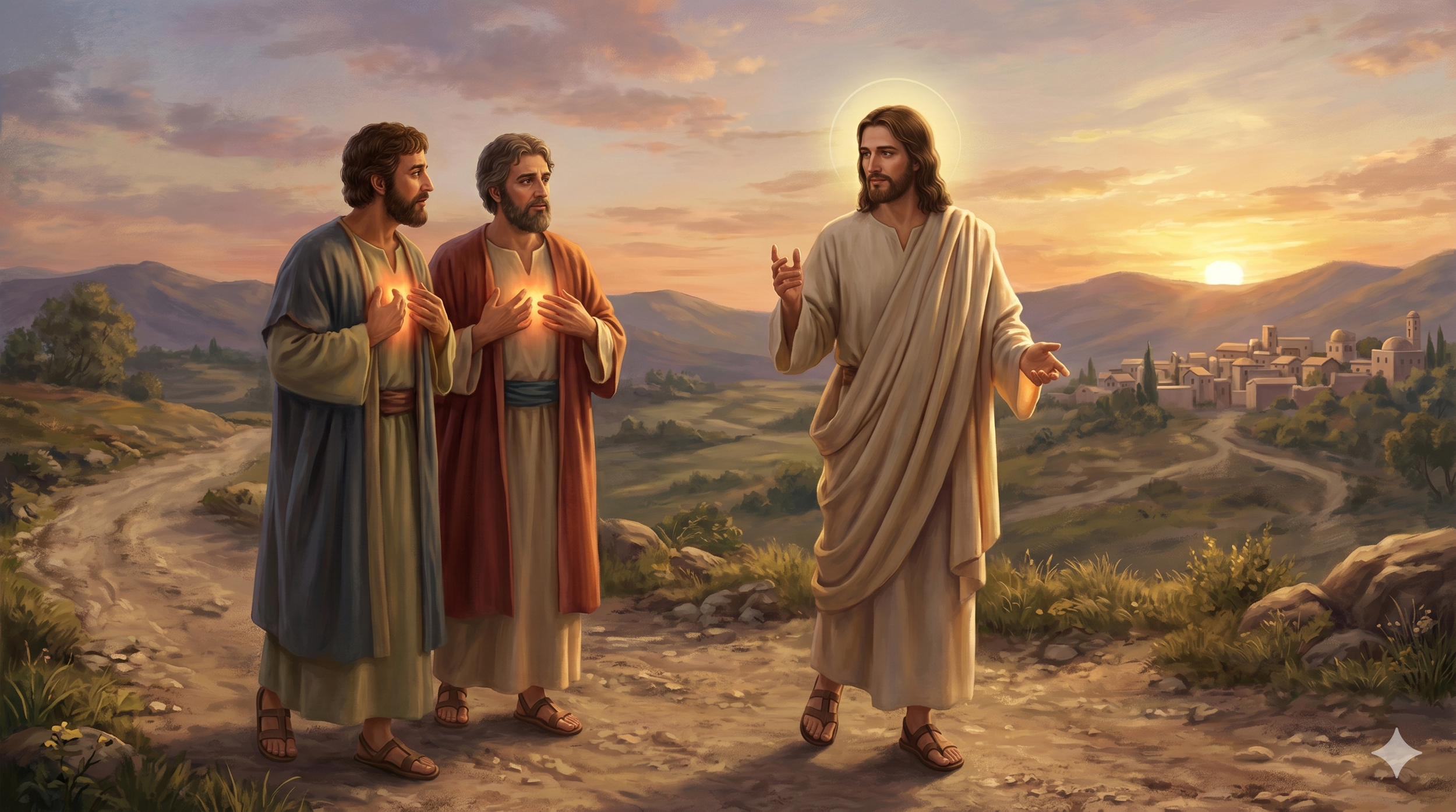
Today's Gospel takes us onto the road to Emmaus, and I think it speaks directly to that question. Because the two disciples in this Gospel were not experiencing grace at all — at least, not at first. They were broken-hearted and in despair. They themselves say, "We had hoped that Jesus was the one to redeem Israel." And now, on Easter afternoon, they were walking away from Jerusalem, away from the apostles, away from the Upper Room. You could say they were walking in the wrong direction.
Isn't it true that each of us can remember a time of walking in sadness and isolation, without hope. In this we are in good company with the two disciples on the road to Emmaus. And haven't you, like me, found that in your times of greatest sorrow and sadness, it is most difficult to pray and to know God's presence?
Not recognising Jesus is part of the pattern of every resurrection appearance. Mary Magdalene at the tomb thought he was the gardener, and only recognised Jesus when he called her name. The disciples fishing didn't recognise him until he told them where to cast the net. And on the road to Emmaus, the Gospel says that something prevented them from knowing him. The risen Jesus is recognised only when he calls his disciples by name, or when they receive a special grace to realise that he is with them.
The Gospel today, the story of the disciples on the road to Emmaus, gives us three ways in which we are called to recognise Jesus in faith.
Firstly, those two disciples had given up and left the apostles. They were walking in the wrong direction. The lesson is in their return — to the community of faith, in the midst of the apostles, in the Upper Room, the place of the Eucharist. Their lesson in the Scriptures from Jesus, and their recognition of him in the breaking of the bread, sent them hurrying back to Jerusalem.
It is the same for us. We are first and foremost a community of believers, and the highest expression of that is when we are gathered for Eucharist. The risen Christ is present when we come together in this church; he is present when two or three of us pray together; he is present when you help your children or grandchildren say their bedtime prayers, and when a family says grace before meals.
There is an old story of a parishioner who challenged his priest about having to come to Sunday Mass. The priest, without a word, picked up the tongs and took a glowing red coal out of the fireplace and set it apart on the hearth. They watched in silence as the coal soon went cold and dark. A coal apart from the fire goes out. A Christian apart from the community loses the fire of faith.
Three Ways to Recognize Jesus
The second way Jesus was present to the disciples was in the proclamation of Scripture. He begins a conversation with them. The Greek word for having a conversation is homileo — the word from which we derive 'homily' — a special kind of sermon where the Scriptures are broken open and explained. Jesus explained the Scriptures to the disciples, and their hearts burned within them. The first reading contains just such a homily by St Peter on Psalm 15 — our responsorial psalm for this Mass — showing how David foresaw the resurrection of the Christ. Peter is preaching to us today as he did to the crowds on that first Pentecost.
How can we read Scripture with open and burning hearts? We can prepare for Sunday Mass by prayerfully reading the Scriptures beforehand, asking the Holy Spirit to speak to us through them; and after Mass, we can share in our families and among our friends what we have heard and understood.
The third way that the disciples on the road to Emmaus met the Lord was in the breaking of the bread. Using the same words as at the Last Supper, Jesus took the bread and blessed and broke it, and gave it to them, and they recognised his presence. The 'breaking of bread' in the New Testament is code for the Eucharist. Just to glimpse what happens in this sacrament — that it is the real presence of the risen Christ, body and blood, soul and divinity — is enough to inspire us to participate in the Mass fully. Nothing should be more important; nothing should keep us away. When we recognise the risen Jesus here, we are strengthened, just as the Emmaus disciples were strengthened to run back to Jerusalem and tell the apostles, "We have seen the Lord."
The journey of those two disciples is so often our journey. The image of Jesus going in search of them is so consoling for us. He seeks us out, walking with us, usually unrecognised, but accompanying us all the same. He heals our broken hearts and makes our hearts burn within us. And then, strengthened by word and sacrament, he sends us out. We are the Emmaus disciples — and we are the Eleven — sent to proclaim, "We have seen the Lord."
So we come back to the question we began with: what grace are we experiencing this Easter? Today we invite Jesus to walk alongside us in our daily lives. We ask him to show us his hands and his feet. We ask him to open our minds to the meaning of the Scriptures. We ask that we may recognise him in the Eucharist. We ask that he make our hearts burn within us with his words.
