

Homily for Divine Mercy Sunday - Second Sunday of Easter, Year A
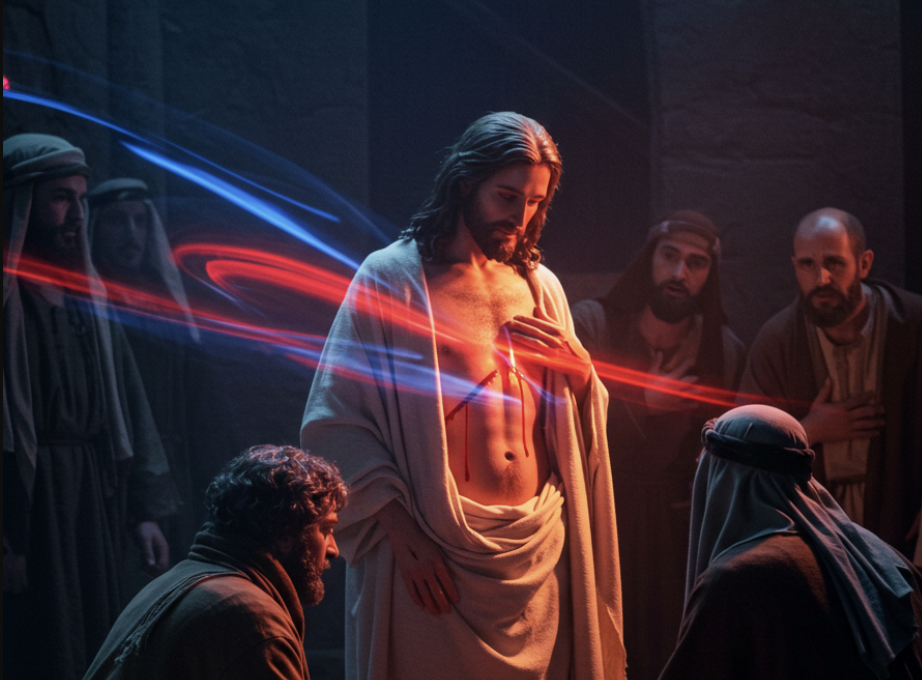
This Second Sunday of Easter, also called Divine Mercy Sunday, might find us in different places. Perhaps we are still trying to get to grips with the Easter message which we started to celebrate last Sunday? Perhaps the week with all its busyness has intervened and we haven't had much opportunity to explore the implications of the resurrection of Jesus, and now we are facing this reality again, wondering what it means and what it has to do with us?
Maybe, like the disciples in today's Gospel, some of us are experiencing confusion and fear. Are we daring to believe — and there is joy in that — but with nagging doubts? Do we have wounds which make it possible to identify with the wounds of Jesus? If any of these scenarios describe us, even a little, then we are in good company with the disciples as they are shown to us in the Gospel for today.
Let's face it; they were utterly bewildered. Nothing could have prepared them for seeing Jesus risen from the dead. Remember that they had known him intimately. And then they had gone through the trauma of loss when he was crucified. To make matters worse they had either denied him, as in the case of Peter, or abandoned him in the time of his greatest suffering. And now they were behind locked doors out of fear that they would be next. The different resurrection accounts all show us something of the confusion, bewilderment, and disbelief of the disciples in seeing Jesus again.
As Jesus meets the disciples in the situation they are in, he meets us this Sunday. No matter who we are, or where we are, we can experience him here and now. Today's readings give us some good hints on how.
Peace Behind Locked Doors
The Gospel tells us that the disciples were behind locked doors because they were afraid, and Jesus came and stood among them, saying, "Peace be with you." And as the risen Jesus came and stood among the disciples, he can come and appear behind the locked doors of fear in our lives. The phrase, "Do not be afraid," appears again and again throughout Scripture, frequently on the lips of Jesus. There is something in that for us. It is as if we have so much in our lives that can cause us to be afraid, and to more than match this Jesus says to us every day, as he said to his disciples, "Do not be afraid; Peace be with you."
What fears are in the background of our lives, that affect our well-being and joy? What wounds do we carry that we might bring to Jesus, who himself carries wounds? This Easter, the Shalom — the Hebrew word for peace that Jesus speaks, is offered to us.
Thomas doubted the resurrection of Jesus; in fact, he said that he refused to believe. Thomas is singled out, but he was probably representative of the others. In their encounter with the risen Christ their fear and unbelief are met by Jesus' gift of peace and the Holy Spirit. And he commissions them to be missionaries of mercy, giving them the power to forgive sins.
This Gospel event is a good description of our own human experience and engagement with the Resurrection. We might be fearful of giving ourselves over to this truth; we experience weakness in living the Resurrection truth; and we have doubts. And like the disciples, we have the potential to move to an experience of faith in the Resurrection and being empowered by the Holy Spirit to be witnesses.
Jesus invites Thomas to put his finger into the holes that the nails had made in his hands, and his hand into the wound that the spear had made in his side. And Thomas responds with the highest and most profound confession of faith found in the Bible. He says, "My Lord and my God." As St Augustine said, "St Thomas touched the man and recognised his God."
Don't you think it is extraordinarily beautiful to consider that the marks of the Passion, the marks of the nails and spear, remain on Jesus' body even after the Resurrection? Not only do these wounds show continuity with the Jesus of Nazareth, whom those first disciples had accompanied, but they are the marks of the mercy of God, the wounds of love, extended to us. They reveal that Jesus is forever fixed in the act of love in which he died.
As Jesus stands before the disciples in the Upper Room, and as he is with us this Sunday as we pray, we see that he is God's mercy to us. The Church Fathers taught that in the blood and water that flowed from the side of Jesus on the cross, flows the mercy of God, the Divine Mercy.
Encountering Christ in Community
So, what does all this mean for us, gathered here today?
The first reading from the Acts of the Apostles gives us a picture. It is an inspiring, joyful image of the early Church in the days following the Resurrection and Ascension — Christians sharing Eucharist, fellowship, prayer, community, and mutual care. The overwhelming sense is of togetherness. This is one of the ways we encounter the risen Jesus: in the Church, in the community, in our learning together, our fellowship together, our worship and prayer together.
What makes this extraordinary community possible? St Peter tells us in today's second reading: in the mercy of God, we have been born again to a living hope — through the resurrection of Jesus Christ. As we gather here today, we hold a profound hope in common. And though we have not seen Jesus, we love him; though we do not see him, we believe in him and rejoice — with what Peter calls "unutterable and exalted joy." Jesus himself says in today's Gospel that we are blessed because we believe without having seen. Peter's confidence echoes what Paul would write elsewhere: "We walk by faith and not by sight."
The story of Thomas teaches us that we encounter the risen Jesus in the Church, together with fellow disciples. Thomas was not with the Twelve when Jesus first appeared to them. He was away from the Church. Only when he was with the Church again, with the others, did he encounter the risen Jesus. It is the same for us. Here together with fellow disciples, in the breaking of the bread and in our prayer together, we experience the risen Jesus.
So, there is something about gathering as a community and praying together that keeps faith alive and strong in us. The Letter to the Hebrews says, we must not neglect to meet together, as is the habit of some, but we must encourage one another. Jesus himself said, "Where two or three are gathered in my name, there I am in the midst of them." Jesus is present with us when we are here together for the celebration of the Eucharist. He wants us to experience him – now, here, in this place.
As we celebrate Mass today, Jesus is before us, with the wounds of love on his glorified body, and we kneel before him in awe and wonder. With Thomas, we say, "My Lord and my God."
