

Feast of Our Lady of Good Hope – 6 September 2026
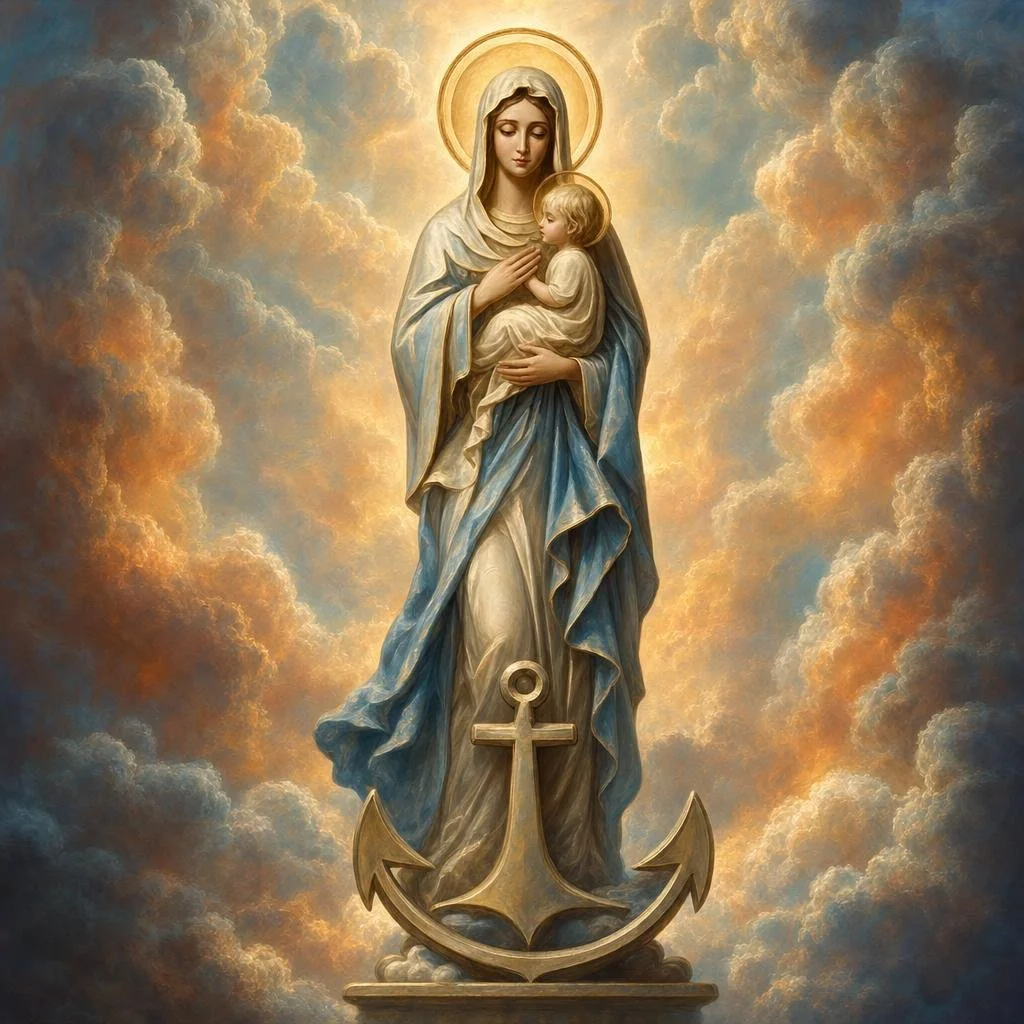
In September 1513, the city of Dijon in France was surrounded. A Swiss and German army, vastly stronger than the local defenders, arrived at the city gates, of all days, on 8 September – the Feast of the Nativity of Our Lady – and camped there. With little military hope left, the people of Dijon did what Christians do when every other hope fails: they turned to their Mother. On the Sunday that followed, they processed through the streets behind a statue of Mary, praying to her under the title Our Lady of Good Hope. The next day, unexpectedly, a treaty was signed, and the siege was lifted.
Centuries later, during the Second World War, when Dijon lay under Nazi occupation, the people once again prayed, “Our Lady of Good Hope, pray for us” – and, again, deliverance came.
The story behind our own parish name is probably different. It likely comes from the Cape of Good Hope: that stormy headland renamed in hope by sailors who trusted they would round it safely. But the deeper truth is the same. Whether people are surrounded by an army or battered by a storm, they need hope. And today we remember that we have a Mother who is a beacon of hope, one we can turn to with confidence.
Christian hope is easily confused
So today we do two things. We honour Mary under this beautiful title, Our Lady of Good Hope. And we ask what kind of hope she teaches us, because Christian hope is easily confused with something much smaller.
Christian hope is not the same as optimism. It is not the vague feeling that things will probably turn out fine. Hope, in the Christian sense, is a theological virtue: a gift from God himself. It is the confident trust that God keeps his promises, and that he will give us the grace we need to reach eternal life with him. As the Catechism says, hope keeps us from discouragement. It is not built on our own strength, but on God's unfailing faithfulness.
An anchor for the soul
It is an anchor for the soul exactly when our own resources, and our own optimism, run out.
Mary lived this hope in the flesh. At the Annunciation, she was asked to trust a promise that defied every expectation, and her yes was a radical act of hope. In the Magnificat, she sang of a God who lifts up the lowly and keeps his word to Israel. She carried that hope through the poverty of Bethlehem and the terror of the flight into Egypt. She held on to it, unwavering, at the foot of the Cross, when hope seemed most impossible. And after the Ascension, we find her again with the apostles in the upper room, praying and waiting for the Spirit: hope holding the infant Church together in its most fragile hour.
Passed through suffering and darkness
Hers was never a naïve hope. It was a hope that had already passed through suffering and darkness, and so it can accompany us through ours.
St Paul tells us in today's second reading that God works all things for good for those who love him, and that he calls us, justifies us, and in the end will glorify us too. Mary's glory is not hers alone. It is the first fruits of the glory promised to every one of us who remains faithful to her Son. She gives us hope not only by her example, but by being living proof of what grace can do with an ordinary human life.
This hope is never meant to be lived in isolation. After the Ascension, Scripture gives us an image of the Church that stands as an icon for this parish: “The disciples went up to the upper room… and they devoted themselves to prayer, together with Mary the mother of Jesus.” They were gathered in the place of the first Mass, as we are gathered here for Mass in this church named for Mary. They were united with the apostles, as we stand in that same apostolic tradition. They devoted themselves to prayer, as we do at this altar, in the most perfect prayer of all: the Eucharist.
A community that knows and carries one another
In our individualist culture, it is tempting to imagine that faith is a private transaction between “me and God.” But God wills a family, a community that knows and carries one another, gathered – as at the beginning – around Mary. Pope Francis once described his vision for every parish as “a community of communities, a sanctuary where the thirsty come to drink… and a centre of constant missionary activity.”
A family of missionary disciples
That is what the parish of Our Lady of Good Hope is called to be: not a place people pass through to receive a service, but a family of missionary disciples who know one another, pray for one another, and go out together to share what they have received. It means each of us taking our own share of responsibility for this community: not standing at the edge of parish life waiting to be served, but stepping in, offering our time and our particular gifts, so that this really does become, in practice and not only in name, a community gathered around Mary.
She wants us gathered not scattered
So what does Mary want for us, her children, in this parish that bears her name? She wants us to come to know her Son, not at a distance, but in a real and living encounter, and that this encounter bears fruit in lives of active discipleship. She wants us gathered, not scattered; engaged, not merely present; giving of our gifts, not simply receiving. She wants us to be, as she was, people who hear the word of God and do it.
And so we ask her intercession today, as the people of Dijon did, and as generations before us have done: Our Lady of Good Hope, pray for us. Pray for this parish, that it may be a true community of missionary disciples of Jesus Christ. Pray for each of us, that the grace which transformed you may go on transforming us, until we, too, come to share in the glory you already enjoy.
We do not stand alone
Whatever storms surround us, and whatever gates seem shut against us, we do not stand outnumbered, because we do not stand alone. We have a Mother who has already gone before us in hope, and who leads us, unfailingly, to her Son. Our Lady of Good Hope, Mother of the Church, pray for us.
