

Homily for the Feast of the Holy Family, Year A
The Holy Family is a model for us as we face the tensions and crises that threaten family life today, inviting us to make our families places of forgiveness, understanding, and unconditional love.
A recent survey in South Africa revealed that single-mother households are the most common expression of family life, with 45% of children living with their mothers only. Only one-third of children live with both parents, a pattern more common in wealthier provinces such as the Western Cape and Gauteng. More than 20% of children live without either parent. Reports also note that millions of children in South Africa are being raised by grandparents in what are called “skip-generation” households.
Interestingly, the survey showed that the most common household in South Africa is what we would call an extended family, where essentially all the members of the household are related. Imagine if we were to conduct a similar survey here in our parish community. What do you think the picture of family life would look like among us?
There are no perfect families. Among us today we represent almost every possible family situation and challenge. Every family has its share of brokenness and woundedness. Many come from single-parent families; some from broken, divorced, or remarried families. Some of us live alone as adults; some are unmarried or widowed. Some live in families formed through friendship and companionship; some have been adopted into families. And the reality is that all families—even so-called “perfect” families—face difficulties: financial stress, conflict and tension, substance abuse, unemployment, illness, and bereavement.
The reason we reflect on families today is that we are celebrating the Feast of the Holy Family within the Octave of Christmas. Over these days we have been celebrating—and trying to come to terms with—the great mystery of the Incarnation: the astonishing goodness of God, the Almighty Creator, taking on our human nature and becoming a defenceless, vulnerable baby. This mystery deepens today as we celebrate the truth that the Son of God did not only become human; he became part of a human family. The Church gives us eight days to allow this mystery of Christmas to sink in slowly.
There is within each of us a deep longing for family, for connectedness and belonging. We instinctively know the importance of family life, even though it is often imperfect. We also know how much effort it takes to create and sustain family life. Holding families together is not easy. Human life is beautiful, but also messy—and families are much the same. This feast encourages us in the work of building and sustaining family life, despite its challenges.
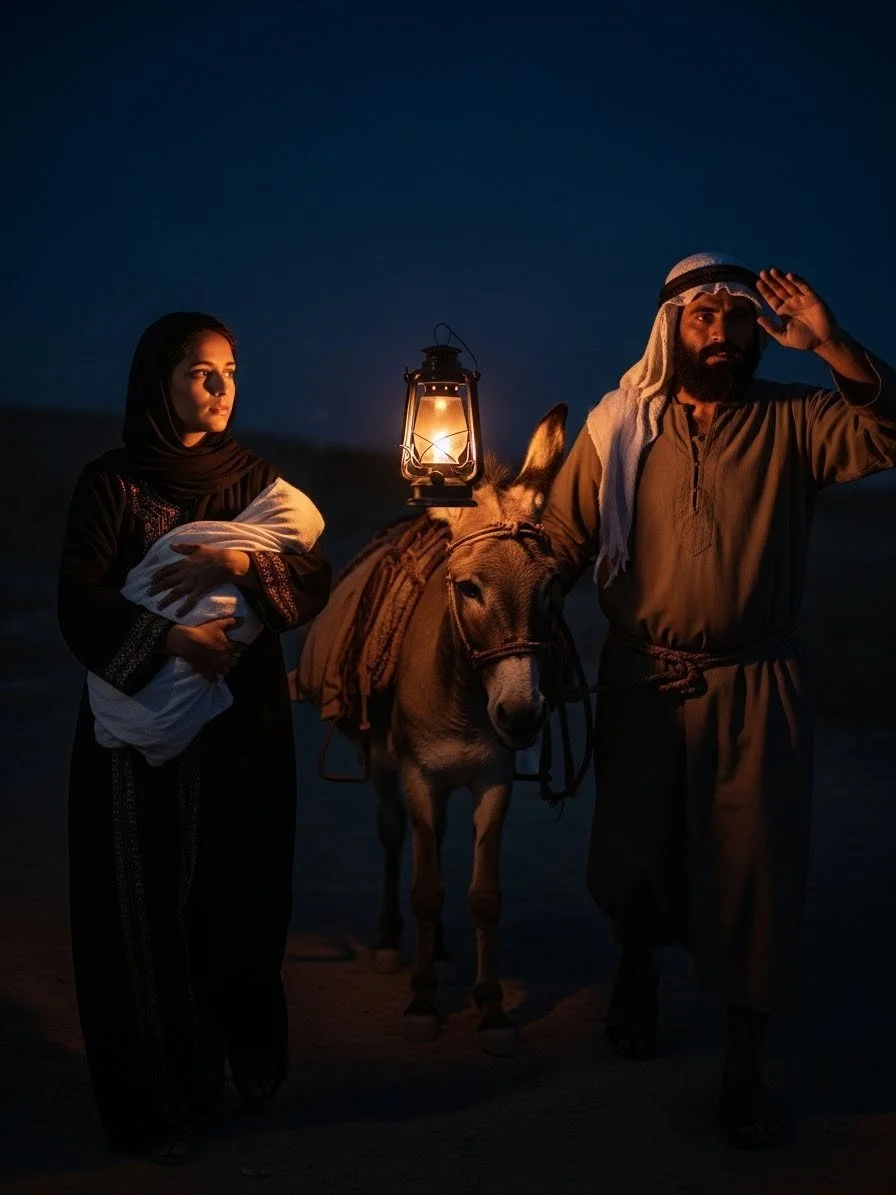
Flight Into the Unknown at Nightfall (AI-generated)
So what does the Feast of the Holy Family have to do with us? Why do we celebrate this family, and why do we hold them up as a model? How are we meant to identify with them? At first glance, it may seem difficult. After all, we are speaking of a woman specially chosen by God, a man who received messages from angels in dreams, and a child who was both divine and human.
And isn’t it true that we often imagine the Holy Family as having lived a smooth and untroubled life—very different from our own families? Yet this is far from the truth. The Holy Family experienced many of the same struggles we face.
What allows us to relate to this extraordinary family is not their uniqueness, but the difficulties they endured and how they responded to them. We are speaking of an unmarried mother; of a couple forced to undertake a difficult journey while the young woman was heavily pregnant. They were poor, with no status or influence. Their child was born in a stable, surrounded by animals.
Today’s Gospel tells us how this family was forced to flee for their lives—at least for the life of their child. They lived as refugees in a foreign country, unfamiliar with the language, struggling to survive. When they returned to Nazareth, Joseph worked as a simple artisan, and Jesus was likely taught this trade. Mary and Jesus would later face the pain of bereavement at Joseph’s death.
This was a family that knew poverty, uncertainty, loss, and sudden change. Their closeness to God did not exempt them from suffering. God did not shield them from hardship; rather, he gave them the strength to endure it. The same is true for our families.
Jesus became part of a human family to reveal God’s plan for our families and to show us their importance. The Holy Family is presented to us not because it was a flawless unit of father, mother, and child, but because of the love they shared and the way they trusted in God’s providence as they faced daily challenges.
This is a Holy Family many of us can identify with. We are all called to be holy families—to create family, to live in loving relationships with others. Even if we do not fit the ideal of a “perfect” nuclear family, each of us is called to build family in the circumstances in which we find ourselves, and to nurture life-giving relationships with those closest to us.
The Holy Family is a model for us as we face the tensions and crises that threaten family life today. This feast invites us to rediscover and celebrate our families as places of forgiveness and understanding—safe spaces of unconditional love, welcome, and acceptance. How do we do this?
The first reading, from the book of Sirach, reminds us of the duties of children towards their parents: respect and honour. It can be read as an explanation of the fourth commandment: “Honour your father and mother, that you may have a long life in the land which the Lord, your God, is giving you.” The text spells out what this honour looks like: helping, obeying, showing patience, kindness, and understanding.
The second reading, from the Letter to the Colossians, speaks about the kind of behaviour that should shape both the Christian community and the family home. The foundation of all Christian relationships is what God has done for us in Christ. God’s love has saved us, forgiven us, and given us peace. We are called to “put on” that same love in our families and in all our relationships.
Today, then, let us give thanks to God for our families and renew our commitment to strengthen family bonds. The Holy Family is not holy simply because of its individual members, but because of their relationship with God and with one another. To what extent can the same be said of our own families?
May our own families — whatever shape they take — be places where God is welcome. May they be shelters of mercy, patience, and hope. And may the Holy Family walk with us, strengthening us, as we try to love one another a little more faithfully, each day.
