

HOMILY FOR FOURTH SUNDAY OF ADVENT
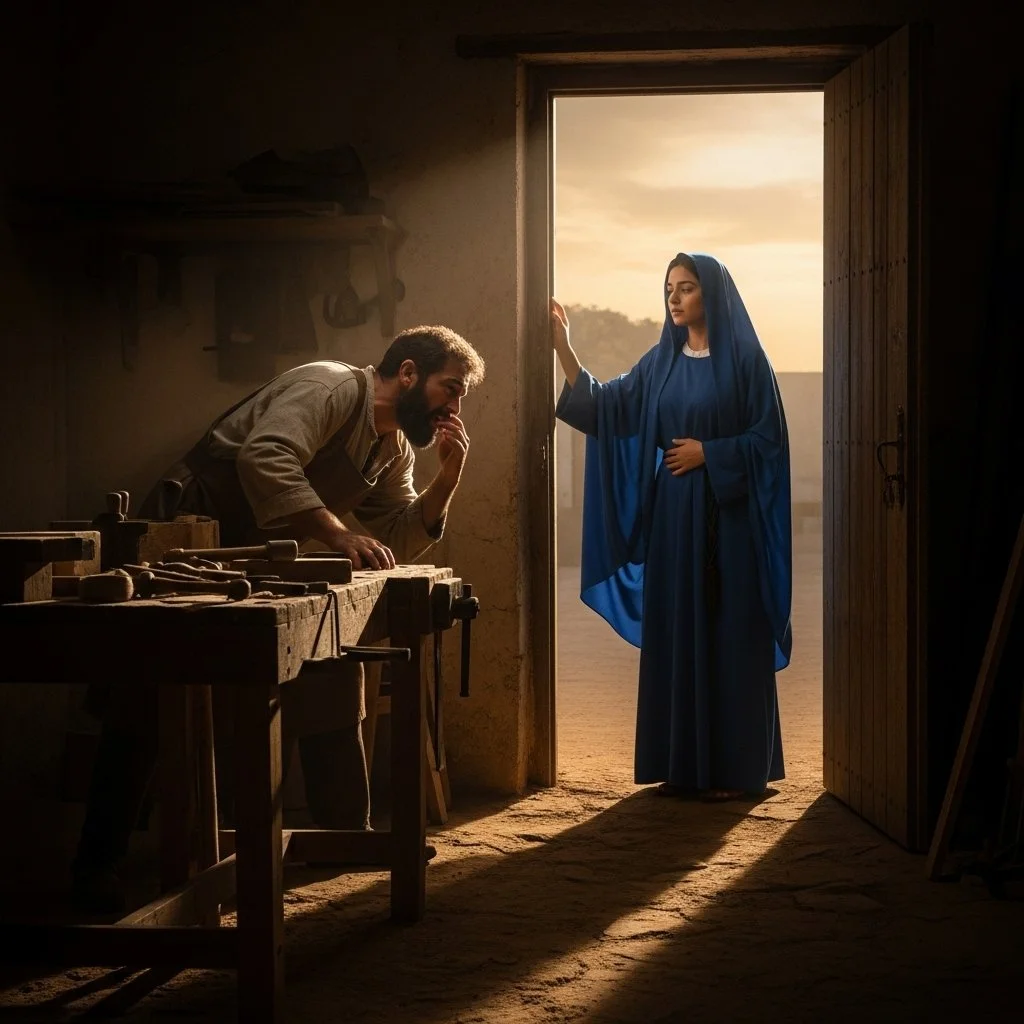
A few years ago, I remember reading about an interview with Pope Francis in which he explained that if there was ever a problem, he would write a message to St Joseph on a piece of paper and put it under a statue of the sleeping St Joseph that he had next to his bed. He said that St Joseph slept on a pillow of little papers, and that to have the statue of the sleeping saint next to him on his nightstand was better than any sleeping pill.
In a similar way, Dorothy Day, the saintly American woman who founded the Catholic Worker Movement and who ran a house for homeless people, used to put the unpaid bills under the statue of St Joseph in the house, asking for his help in paying them.
It is worth considering what keeps us awake at night. What are our worries, fears, and anxieties? What would we write on a little piece of paper to put under the statue of the sleeping St Joseph?
This statue of St Joseph sleeping reminds us of how St Joseph received his messages from God. It was in his dreams that he was told he should take Mary as his wife, and that he must take her and the Child to flee from Herod. Consider how God invaded St Joseph’s life. Consider the significant role that he played in bringing the Christ-child into our world.
And so, the Gospel reading for Mass this weekend centres on this person of St Joseph. In Matthew’s Gospel, in the account of the birth of Jesus, the focus is more on St Joseph because Matthew originally wrote his gospel for Christians of Jewish descent and he wanted to demonstrate to them that Jesus is the Messiah promised by the prophets of the Old Testament, as coming through the line of King David. Joseph himself was a direct descendent of King David, indeed the angel addresses him as Joseph, son of David.
And we know that Joseph names the child, adopts him, nurtures him and protects him. The child is the Son of God and son of Mary, but also, through Joseph, the son of David. St Paul, in his letter to the Romans, for our second reading, writes of the Good News about the Son of God who, according to the human nature he took, was a descendant of David.
One of these prophecies of the Old Testament about the coming of the Messiah as a little baby is seen in our first reading today from the prophet Isaiah. More than 700 years before the birth of Jesus, the prophet prophesied to King Ahaz of the House of David about the virgin bearing a child, who is to be known as Emmanuel, which means “God-is-with-us”.
In the reading from Matthew’s Gospel, we find that Matthew refers directly to this prophecy. The virgin birth of Jesus is given by Matthew as a proof that Jesus is the long-awaited Messiah of whom the prophets of the Old Testament spoke about.
The prophecy that King Ahaz receives is in the context of impending doom for his kingdom. The Assyrians were on the brink conquering the whole region, and at the same time two powerful neighbours are threatening to invade. Ahaz was in deep distress and had given up hope. He saw the end of his kingdom and his kingly line. Into his despair and distress God spoke through the prophet Isaiah this extraordinary hope and encouragement - the promise of an heir. This sign is given to the king to assure him that God is with Israel. Sadly, Ahaz refused to believe in the sign and trust in God.
The situation of Joseph was not much different to that of Ahaz, if you think of it. The Bible leaves out so much detail about the anguish that Joseph must have experienced. But, imagine it, his betrothed had been found to be pregnant, and he was not the father. He must have been utterly crushed. His whole future, the life he had imagined must have come crashing down. And into his despair and distress he received this message from the angel about Emmanuel, God-with-us. But, unlike, Ahaz, Joseph put his trust in God and was obedient to the instructions of the angel.
In what ways could it be said that our lives reflect the kind of anguish and distress of Ahaz and Joseph? All of us have known difficulty, suffering, anguish and despair at some time or another. Perhaps at this time, there are those among us who are struggling, perhaps some who have lost of sense of God’s love for them or have lost a sense of meaning and purpose. Perhaps some feel stuck in a rut or crushed by the guilt of their sins. Christmas comes to give us the hope of new life, because God is Emmanuel, God is with us. He will never abandon us or give up on us. Are we more like Ahaz or Joseph in the face of the hope that is promised us this Christmas?
“What if God should become one of us?” What does it mean that God is Emmanuel, God-with-us? These questions have been echoing in the readings and prayers of our liturgy these past few weeks. These questions sum up the whole meaning of Advent and Christmas. The resounding truth is that God has become one of us. At Bethlehem 2000 years ago God took on human nature in Jesus Christ, Son of God, Son of Mary, and Son of David, in fulfilment of the ancient prophecies.
To understand the impact of this event on early Christians and particularly the Jewish-Christians, we have to understand the profound reverence and utter respect that Jews had even for the name of God. They would not even speak or write the name of God. Can you imagine what impact the truth that God has taken on human nature would have had on such people? It would have blown their minds.
This Christmas we need to allow ourselves to be shocked by the profound truth that we celebrate: God has come as one of us and God is with us. We need to reactivate the surprise and scandal in our minds and hearts that God has become one of us.
If you accept this truth, if you buy into this earth-shattering reality, life is changed forever. Christmas cannot be trivialised or sentimentalised and any attempt to do so must be resisted at all costs. If God has come as one of us, the course of human history is forever altered. The meaning of human existence is changed definitively. The course of our personal history and the meaning of our personal existence is irrevocably changed. If we grasp the truth of this birthday, our way of understanding God, other people, ourselves and the purpose and direction of our lives, cannot be the same again.
The Gospel says that Joseph woke up and did what he had been commanded to do. In what sense do we need to wake up, hear the Gospel, trust in God again, and do the will of God? The Virgin birth means that God has invaded our world. Let’s allow God to invade our hearts and lives in the way Joseph’s life was transformed. God is with us. Are we with God?
Matthew says that Joseph is told to name the child, Jesus, with the implication or meaning that he is the one who will save his people from their sins. Jesus has entered the sin and brokenness of our lives and our world and brings forgiveness, hope and healing. What aspects of our lives long for the Saviour? St Paul writes to us, here in today, as he wrote to those in Rome, “To you all, then, who are God’s beloved, called to be saints, may God our Father and the Lord Jesus Christ send grace and peace.
