

Let Jesus gentle and humble of heart take up the yoke beside us
Homily for 14th Sunday of Ordinary Time, Year A
At the beginning of my Camino pilgrimage in Spain in 2023, on my way to Irun in the north where I would begin to walk, I spent the first night in a city called Burgos. The next morning, I went to Mass at the Cathedral, and I saw something that stayed with me for the rest of that pilgrimage and which has become an iconic image that I refer to often.
There was a young man in his early 30’s within my line of sight. At Communion time, instead of going up for Communion, he remained kneeling, and presuming that no-one would notice, he was discreetly striking his chest. I was deeply moved by his raw authenticity before God, and while I could not know what his story was, it was a powerful reminder that each one of us has a back story; each one of us has our issues, our wounds, our sins, and weaknesses. The priest in me prayed for him and longed for him to be able to receive Communion. I could not know his story, but I could give him to God. It struck me that this man is an image of us – who we are before God, and today’s readings show us how God reaches out to us.
We must not be misled by the word “easy” in terms of the kind of yoke Jesus invites us to take. The root word in Greek means a tailor-made yoke: a yoke that is “well-fitting.” The yoke Jesus invites us to take, the yoke that brings rest to our weary souls, is one that is made exactly to our lives and hearts. The yoke he invites us to wear fits us well, does not chafe us nor cause us to develop sore spirits. As are all yokes, the yoke that Jesus offers us is designed for two. And our yoke-partner is none other than Jesus himself. Jesus meets us in our human condition and walks alongside us, sharing our burdens.
All of us have at some stage and perhaps often, asked, “What is God like?” We could never fully or adequately describe God, but today's readings give us a good idea of what God is like in terms of how he relates to us. The responsorial psalm of the Mass summarises these attributes of God. We hear that the Lord is kind; he is full of compassion; he is slow to anger; he is abounding in mercy; and he is good to all. Further, the Lord is faithful in all his words; and holy in all his deeds. The Lord supports all who fall and raises up all who are bowed down. This is a God who corresponds to the deepest yearnings of our hearts.
All of us long to experience a God who is like this. And in fact, from today's readings it is clear that we are invited to draw closer and experience God as being like this. This is the God for whom our hearts were made, and our hearts are restless until they find their rest in him.
Think of the young man kneeling in the cathedral at Burgos, striking his chest in prayer, and consider how God would have loved him. We are like that man before God and we are loved. What does it mean to say that God is kind? We might refer to a person as kind if that person were considerate towards others; if that person were gentle and selfless in the way he or she treated others. God is kind to us. He pours himself out for us in gentleness; he looks upon us with kindness. God is full of compassion for us. God knows us each individually. He knows our sufferings and our joys, our strengths and our weaknesses.
Our lives involve a certain amount of suffering, and some people seem to suffer more than others. We all know of people who suffer illness; those who struggle in different ways, those who are bereaved; those who suffer poverty and unemployment.
God looks on those who suffer with compassion and special love. Even though suffering is a great mystery which we will never fully understand, we know from the Bible that God is especially close to those who suffer. God sees those who are suffering and has compassion for them. Suffering does not mean the absence of God! Rather, God comes very close to those who suffer, taking up, as we have said, the yoke beside us.
And God is slow to anger. We human beings have our weaknesses, and we are prone to sin. By our sins we offend God and God might be rightly justified in being angry with us in our sin; but the Scriptures tell us that, on the contrary, he is slow to anger. We could say that rather than be angry he is saddened by our sins. In the death and resurrection of Jesus he makes it possible for us to be forgiven of our sins, rather than have to experience the punishment that our sins deserve. In a word, God is merciful.
God is abounding in merciful love, and he is holy in all his deeds. God is constantly working in our lives for our good. The love that we experience among ourselves and which we have for others is only a fraction of the love that God has for us. God's love could never be measured or compared to any other love. God is love himself.
We see hints of the immense love of God in the person of Jesus, who gave up his life for love of us. This merciful love is seen every time we participate at Mass, and we remember in a special way Jesus’s death for love of us, on the cross. This love is seen in the Eucharist itself when Jesus gives himself to us completely in the form of a little piece of bread.
God is faithful in all his words. We can rely on God because he is faithful. Even though we might be unfaithful at times, God is always faithful. We know from experience that a friend who changes their mind often, who is there sometimes when we need them and not there at other times, cannot be fully relied on. God on the other hand can be fully trusted. He is always there for us, and he is always loving us. The Gospel reading today sums up all we have been saying about the nature of God. To have seen Jesus is to have seen God the Father. The Father shows us the Son, and the Son shows us the Father.
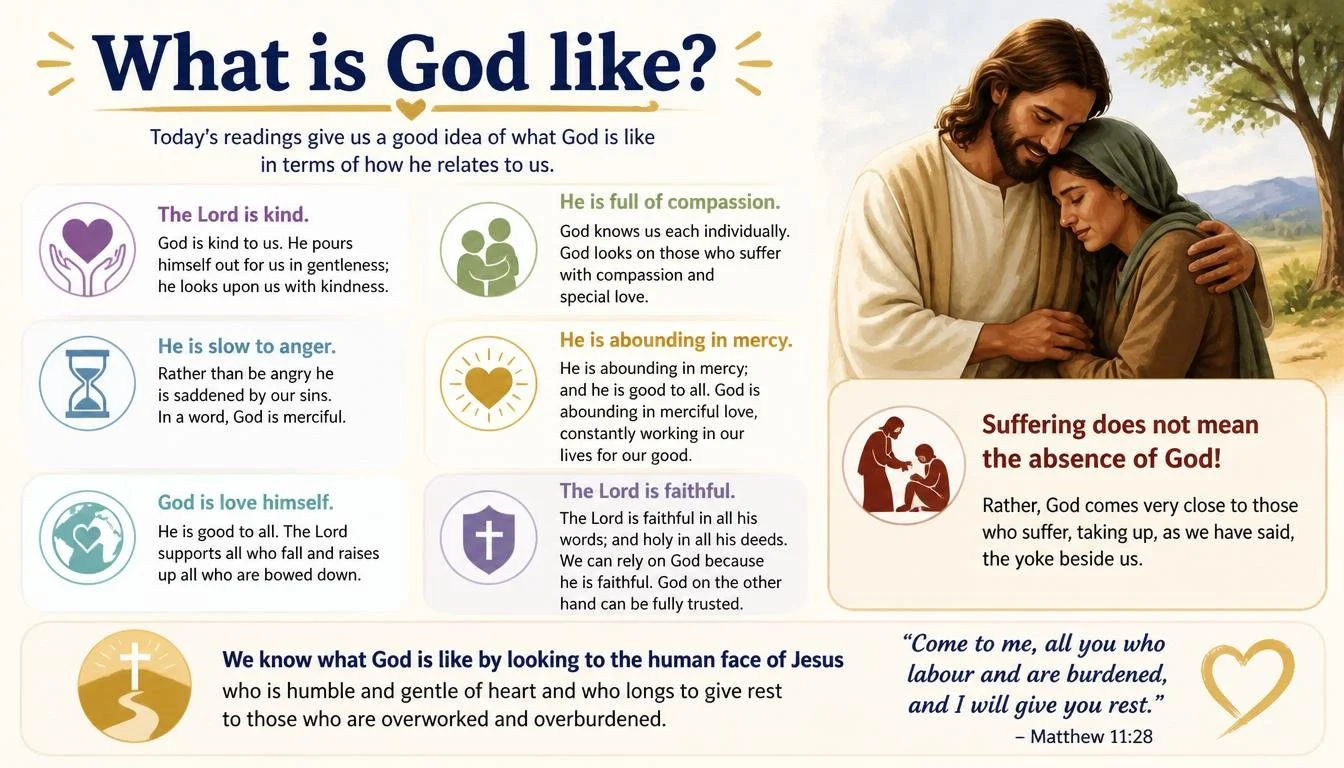
Pope Francis opened his document for the Year of Mercy with these words: “Jesus Christ is the face of the Father's mercy”. We know what God is like by looking to the human face of Jesus who is humble and gentle of heart and who longs to give rest to those who are overworked and overburdened.
All of us have our burdens and our worries, and Jesus invites us to come to him and find rest in him. It is true that we might find that in coming to Jesus with our burdens that they are not automatically taken away, but they will be easier to bear with the love and help of God. Often, we know this most confidently with hindsight; that God was close to us strengthening and supporting us.
The prophet Zechariah foretold this king long before he came: one who would enter the city not as a warhorse-riding conqueror but humbly, on a donkey, ruling not by force but by love. This is the king we are called to welcome into the city of our lives, into the rooms of our lives, into all the aspects of who we are.
Today let us take up his invitation and come to God who is all love and compassion. There is a pious legend that Jesus, the carpenter, was one of the master yoke-makers in the Nazareth area. He would measure each team of oxen by hand – their height, their shoulders, the space between them – and craft a yoke, fitted perfectly, for them and no other.
This is the Jesus we meet today: the carpenter who still measures each of us individually, who still fashions a yoke to fit our particular shoulders. It is this Jesus the young man in Burgos met that morning, kneeling before the altar, unable to go up, yet striking his chest and bringing all that he was, unspoken, directly to Christ. We do not need to explain ourselves fully either. We need only come, as he did, and let Jesus, gentle and humble of heart, take up the yoke beside us.
