

Act in Faith
Homily for Nineteenth Sunday – 9 August 2026
On the night the Titanic went down, Fr Thomas Byles was not swept into the chaos on deck by accident; he chose to enter it. He had said Mass for third-class passengers that very morning. When the ship struck the iceberg, he was walking the upper deck, quietly praying his breviary. As panic spread and the lifeboats filled, he was offered a seat twice. Twice he refused it. He chose to stay with more than a hundred passengers trapped below deck, with no way off the ship. In their final hour together, he heard their confessions, gave them absolution, and led them in the rosary as the freezing water rose around them.
Nothing about that choice was loud or dramatic — no vision, no thunderclap of certainty. It was the same quiet, steady conviction that had shaped his whole priesthood. Imagine the interior struggle in those moments: follow the instinct of self-preservation and get into a lifeboat, or stay with those who needed him. Courage like that rarely announces itself. It is what remains when someone has spent a lifetime listening for a voice most of us are too afraid, or too distracted, to hear.
Nothing draws our attention quite like a whisper
Isn't it true that nothing draws our attention quite like a whisper? And yet, in the noise of our lives, we might easily miss a message given in a whisper. We can fall into the trap of thinking that God has gone silent. Really, we have been listening for a shout, while God often chooses to whisper. That means we need to quieten down, as Jesus did when he went into the hills by himself to pray. We need to tune our interior ear. And as we listen, we find not only our answer — we find ourselves drawn closer to him. Sometimes God whispers precisely so that we will move closer to hear him.
Elijah, in today's first reading
Elijah, in today's first reading, is a man on the run — his life is in danger, his vocation is in doubt. He is physically, emotionally, and spiritually drained. He is angry with God. He is bewildered by how God seems to be working in the world. It’s a description that fits most of us at some point — worn down, unsure whether God is even listening. We might prefer God to speak in a mighty wind, an earthquake, a fire — something unmistakable. Instead, God comes to Elijah, and to us, in silence and whispers. The question is not whether God is speaking. It’s whether we've made room to hear him.
Elijah had to climb the mountain. Jesus went into the hills to pray. Peter had to step out of the boat. Hearing God asks something of us. It asks us to leave the noise, leave the safety of where we are, and place ourselves where God can be heard. Perhaps we have grown so used to the silence that we have stopped expecting God to break it.
In today’s Gospel, the disciples
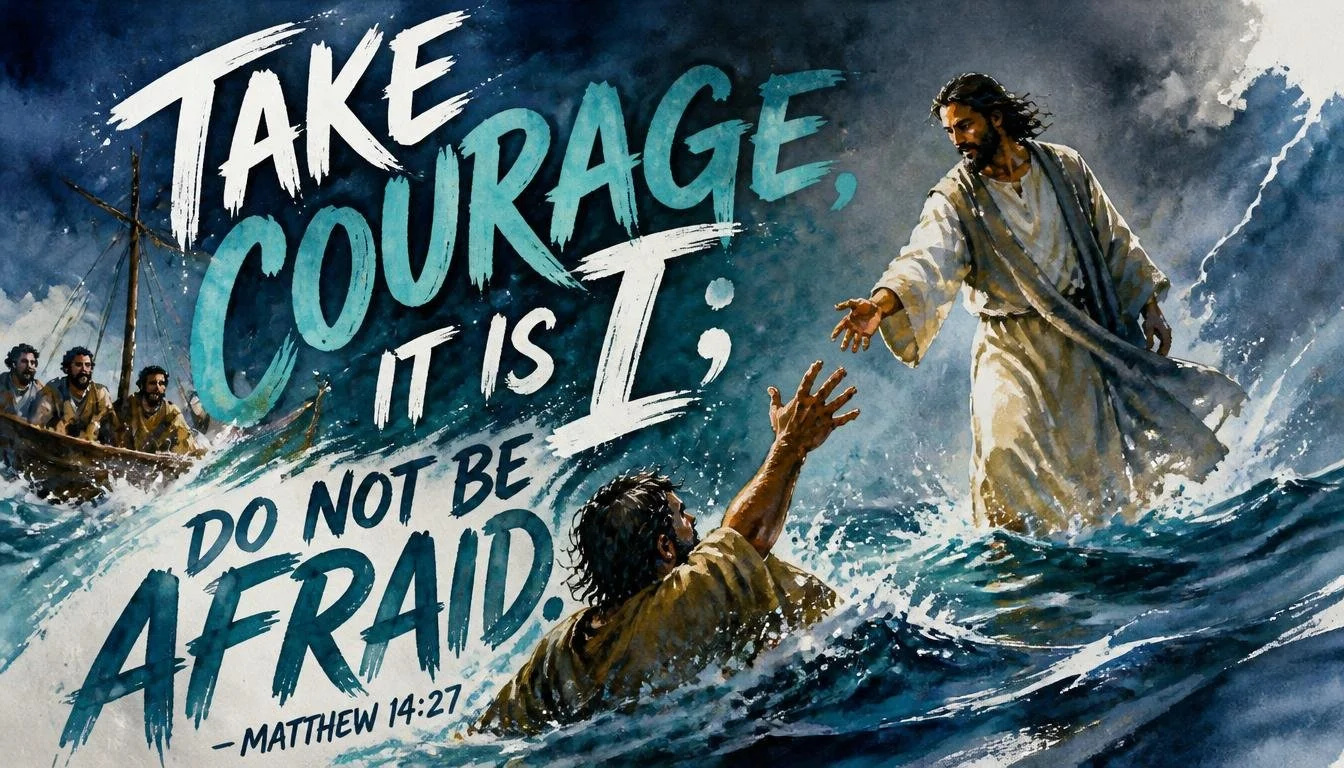
In today’s Gospel, the disciples are out on the sea at night, battling a storm — frightening enough on its own. But nothing prepares them for the sight of Jesus walking toward them on the water. They think they are seeing a ghost. Into their terror, Jesus speaks: “Take courage, it is I; do not be afraid.” In Greek, “it is I” is ego eimi — “I am.” These are the very words by which God announced himself to Moses at the burning bush. Jesus is not simply identifying himself to frightened friends. He is speaking the divine name into their fear. There is no storm, and no threat, great enough to stand outside his presence.
In this Gospel event we are seeing a parable of the Church itself, represented by the disciples in their fragile boat, surrounded by hostile winds and waves. Whenever we come across the picture of the disciples in a boat on the sea, we are supposed to recognise an image of the Church. As much as the disciples of Jesus in the boat experienced fear and anxiety, the early Church did too, and the Church in different parts of the world today continues to experience difficulties.
The disciples in the boat are also an image of us in our individual and family daily lives. Think of the storms of life we face. Each of us has our own struggles at different times of our lives. Relationship problems, illness, financial difficulties, persecution, loneliness, depression, fear, anxiety, and doubt are all part of the human condition.
This Gospel scene unfolds in “the fourth watch of the night,” around three in the morning. That is the hour many of us know — the hour when anxiety floods in, when reason goes quiet, and when fear is hardest to hold at bay. It is into storms like these — ours and the Church’s — that Jesus comes, saying, “Do not be afraid.” Scripture returns to that phrase again and again. Because there is a fear at the heart of every one of us. And only his presence can answer it.
Peter answers with a bold request
Peter answers with a bold request: “Lord, if it is you, command me to come to you on the water.” “Come,” Jesus says — inviting him out of the safety of the boat, into the wind and the waves. Peter steps out. He does walk on water, however briefly. Then his fear gets the better of him, and he begins to sink. His cry — “Lord, save me” — is the same prayer offered by every believer who has ever gone under.
Notice what happens next. Jesus doesn't wait for Peter to recover his nerve. He doesn’t wait for his faith to steady first. As Peter is sinking, Jesus reaches out at once and catches him. The step of faith doesn't have to be perfect. It only has to be taken.
Once Peter and Jesus are back in the boat, the wind dies down. The disciples worship him. They recognise what people of that time understood: only God can calm the sea. The Son of God is among them.
We grow in faith the same way. By stepping out. By persevering. By trusting. We come to know the saving power of God for ourselves — not just as something we've been told.
This is the same lesson Elijah learned on the mountain. Not in the wind. Not in the earthquake. Not in the fire. But in the sound of a gentle breeze — a still, small voice. And Elijah knew: he was standing in the presence of the Lord. And he covered his face.
Our lives are a journey of trusting Jesus more deeply, of letting him speak into our fears. It is when we are most alone and afraid — in our own fourth watch of the night — that he comes closest. That's when he invites us to step toward him.
That is what Father Thomas Byles did, on a sinking ship in the dark of the North Atlantic. He had spent a lifetime tuning his ear to a quiet voice. So, when his own storm came, he recognised it at once. He knew exactly where to stand — not in the safety of a lifeboat, but beside the people who needed him most.
Most of us will never face a night like his. But each of us will have our own fourth watch. Our own wind and waves. Our own moment to decide, to act in faith — whether that means staying beside those who need us most, as Fr Thomas Byles did, or stepping out onto the water like Peter.
The invitation is the same one given to Elijah on the mountain, to Peter on the water, and to a priest on a sinking ship. Quieten down. Listen for the whisper. And when he says, “Take courage, it is I; do not be afraid,” act in faith; step out onto the waters.
