

Becoming Love: How Our Choices Shape Us Into the People God Calls Us to Be
Homily for Sixth Sunday in Ordinary Time, Year A
There's an old story about a missionary who was trying to explain the Christian faith to an aged tribal chieftain. The chieftain kept clarifying with the missionary on different points, such as, “You mean I must not take my friends’ wives?” “And not rob their goats and cattle?” “And not kill warring chieftains?” To each of these clarifications the missionary affirmed, “Yes.” The chieftain then concluded, “Well then, I’ll be a good Christian because I am too old to do any of those things.”
Most of us for most of the time have rather a complicated relationship with the law. While we might begrudgingly accept that the law is necessary, at the same time we might see the law as restrictive and limiting, or perhaps even frightening. The problem comes when we transfer our different understandings of law to our religion.
This Sunday’s Gospel comes from a Jesus’ Sermon on the Mount as recorded by St Matthew. Essentially the Sermon on the Mount is a collection of the sayings and preaching of Jesus, and Matthew portrays Jesus as the new Moses who gives the new Law for the new people of God.
The powerful invitation of the Sermon on the Mount is to make good and holy choices from the heart - a call to be righteous. To be righteous is to go beyond the minimalist keeping of a set of rules and regulations. It means a deeper discernment of the plan of God. It means to go beyond the mere avoidance of gross crimes like murder, adultery, and breaking of oaths, to a deeper life of freedom from anger, lust, and deceit. We are called to embrace the plan of God. We are called to take on board the deeper meaning behind these rules and regulations.
Most times when ordinary people think of religion, they think of list of dos and don’ts, with a greater emphasis on the don’ts. How often don’t people reduce religion to nothing more than the Ten Commandments? The problem with this kind of thinking is that religion becomes a burden with a whole lot of negative language. We need to move beyond a list of do’s and don’ts to be motivated by the beauty, harmony and peace that comes from living in God’s will, according to his plan for our happiness.
Surely, it is true to say that each one of us wants to live well and do the right thing? The question, “What must I do?” is one of the fundamental questions that we as human beings ask and seek to answer over and over again through our lives. We want to live in peace and harmony. We want to experience goodness within ourselves. Instinctively, we know that doing wrong catches up with us and makes us miserable; it hurts us, and others.
So how do we understand the call to live the Law in the manner that Jesus wants us to? We read from the Old Testament prophets frequently, and we see in them a preparation for the coming of Jesus. In Jesus we see that the message of the Old Testament prophets has been fulfilled.
As we hear in today’s Gospel, far from abolishing the law and the prophets of the Old Testament, Jesus came rather to uphold and fulfil them. The purpose of the law and the prophets of the Old Testament was to prepare the people of God for the salvation that would come with the sending of the Messiah. Jesus, when he came, gave the law and prophets their proper interpretation.
Whenever we come across this Gospel passage about Jesus fulfilling the Law and prophets, we can think of the Emmaus Gospel story. It’s the resurrection narrative where Cleopas and another disciple in utter despair and dejection following the crucifixion of Jesus, leave Jerusalem for Emmaus. On the way Jesus walks alongside them and enters into conversation with them, without them recognising him.
Jesus challenges their despair saying, “Oh, how foolish you are! How slow of heart to believe all that the prophets spoke! Was it not necessary that the Messiah should suffer these things and enter into his glory?” Then beginning with the Law given through Moses and all the prophets, he interpreted to them what referred to him in all the scriptures. And once they reached Emmaus, they recognised Jesus in the breaking of the bread, and they said: Did not our hearts burn within us as he spoke to us on the way and opened the Scriptures for us.
While we, the people of the New Testament, are not under the Jewish Law, we see in Jesus, the giver of the new Law. This new Law is not written on tablets of stone but written on our hearts. Jesus came specially to fulfil the deep longing in the human heart for happiness, which is ultimately found in eternal life with God.
The first reading from the book of Sirach explains the enormous respect that God has for human freedom. We can choose what we want and how we will act. We can choose to keep the commandments, and the reading says that they are not impossible for us to keep. A God who gave us a set of commandments beyond our ability to be faithful to them would not be a loving, compassionate God.
The great value of our human freedom is that we can love. If we did not have freedom, we would not be able to love. Love is a choice, a decision, an act of the will, freely chosen. God gives us the commandments not as arbitrary standards to lord his authority over us, not just to spoil our fun; but rather because God who created us, knows us intimately and knows what is best for us. God wants us to flourish, and his commandments are a blueprint for human fulfilment.
The beauty of this human freedom, this being able to choose, is that we are constantly becoming what we choose. Of course, there is the sad possibility that we would choose not to love. Our human freedom means the possibility of choosing the opposite of love. We can choose to be selfish and self-centred, but ultimately this will make us sad and unhappy, and our lives will be meaningless and without hope.
But by choosing the good, we are constructing ourselves, shaping ourselves into that which is good. By choosing to love, by choosing to be unselfish, by choosing to be compassionate and Christ-like, we are becoming progressively more and more that which we choose.
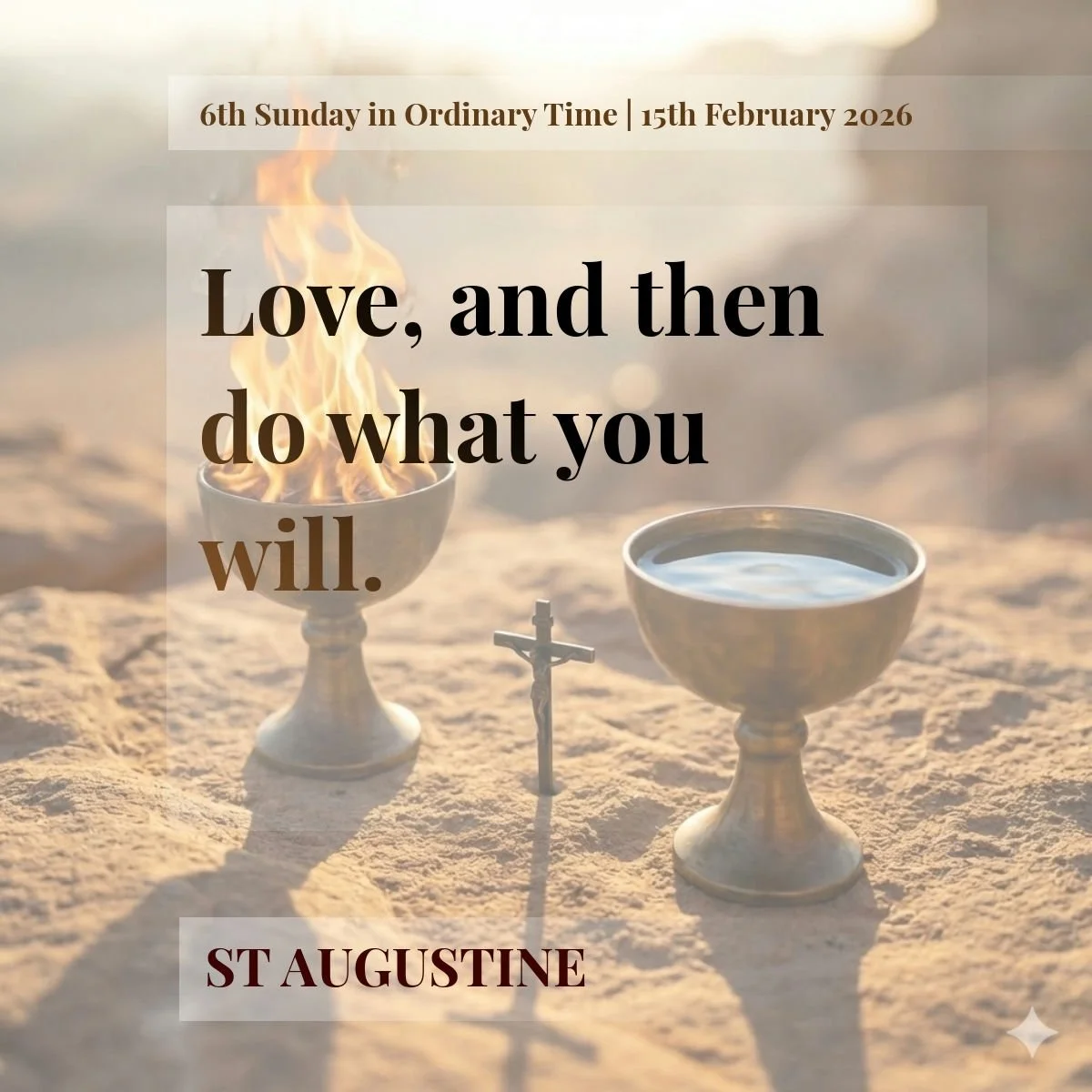
As Christians, we are bound by the Law of Love. Jesus, himself, summed up the Old Testament commandments as love of God and love of neighbour. St Augustine’s famous line is: “Love, and then do what you will.” In other words, if we are fulfilling the precepts of love in all things, there is nothing more required of us. Love is the fulfilment of the Old Testament Law and Prophets, and the basis of the moral law. So, love and then do what you will.
