

HOMILY FOR PALM SUNDAY, YEAR A – 29 March 2026
With this Palm Sunday celebration, we begin Holy Week, the most sacred time in our liturgical year. It will be a week filled with human and spiritual drama.
The readings for the day can be accessed here.
The Gospel at the beginning of Mass tells how the week began and the Gospel we have just heard tells how it ended on the first Good Friday.
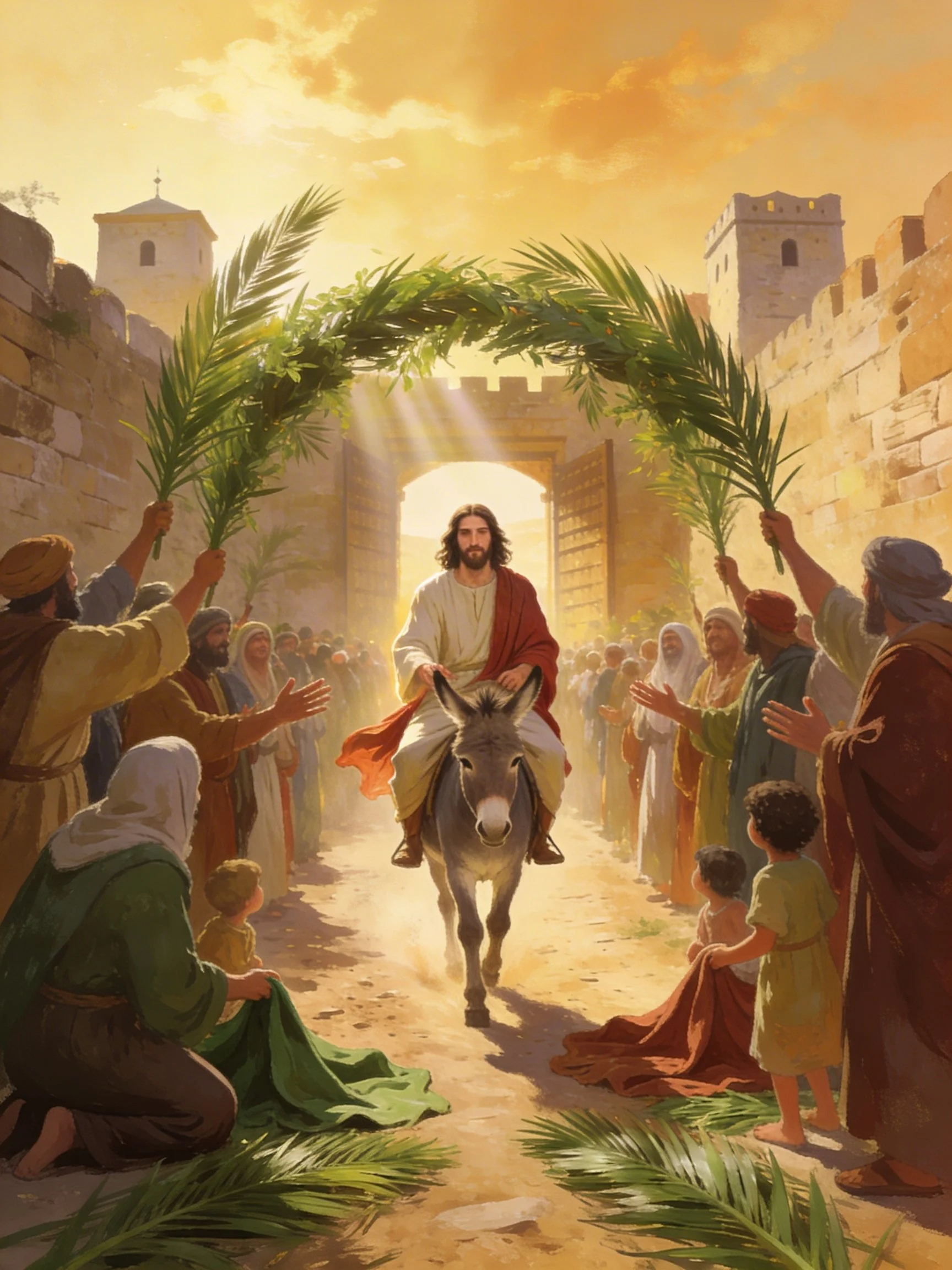
The Gospel of the entry of Jesus into the city of Jerusalem, shows the crowd accompanying Jesus, rejoicing, and praising God for the mighty works they have seen in Jesus. The crowd proclaims Jesus to be 'the King who comes in the name of the Lord.' We see that Jesus enters Jerusalem on a donkey, in fulfilment of the ancient messianic prophecies. We are in that crowd today. We have been travelling with Jesus to Jerusalem right through Lent, to this point at the beginning of Holy Week.
We have just heard the Passion of Jesus according to St Matthew. Many scholars believe the Passion narratives were among the first parts of the gospels to take shape. These accounts of Jesus' betrayal, arrest, condemnation, suffering, and death helped the earliest believers to stay in touch with what they had come to understand as the ultimate expression of God's saving love. This is what our celebration today is about. Indeed, it is what the celebrations for this next week, Holy Week, and especially the Sacred Triduum, are all about.
The Drama of Holy Week
This week, we will witness the betrayal of Jesus by his closest friends, we will see human weakness in the disciples in not staying awake with Jesus in his agony, we will see violence against Jesus, his arrest, torture and execution. We will witness fear, abandonment, and desertion, lies and false witness, and denial by Peter and despair in Judas.
This week we will witness a king riding on a donkey rather than a war horse, in fulfilment of the prophecy of Zechariah. We start with a triumphant, joyful entry into Jerusalem as Jesus is welcomed as the Son of David, the Messiah – an entry which will end in a shameful exit from the city with Jesus carrying a cross.
As the Passion of Jesus according to Matthew is proclaimed in our hearing today, we are invited to become active and empathetic participants. By living through the events of this week, we can consider with whom we each identify most. Are we more like the vengeful religious leaders, ... or the jeering crowds, ... or the shrewd Pilate, ... or the fearful disciples? Perhaps we can identify with Peter who denied Jesus, ... or even with Judas who have up hope and despaired. Perhaps we can identify the faithful women and St John who stayed with Jesus to the end, ... or perhaps the crucified criminals on either side of Jesus.
The point is that we find a point of entry either through identifying with one of these characters or one of the events and get close to Jesus, to live through his Passion with him in some way. Let's allow ourselves the space and time to be moved and humbled at the sight of Jesus on the cross, who emptied himself and sacrificed himself out of love for us.
## God's Ultimate Saving Love
Whoever we identify with in the account of Jesus' suffering and death, we have a place in the heart of Christ. He identifies with us in our weakness and sinfulness. Jesus' passion and death is the ultimate expression of God's saving love. It was for us that Jesus willingly underwent this suffering and death. It is a supreme act of love for us. This is why we recall it today and this week, and indeed why we celebrate it.
Perhaps we have come to the end of Lent more conscious of weaknesses and frailty, our sinfulness and lack of faithfulness. Perhaps our Lenten journey has brought us to recognise our utter dependence on the mercy of God given to us in Jesus Christ. This will mean we can look to Jesus on the cross and experience his merciful love.
Today we acclaim him and welcome him, together with the crowd of pilgrims who accompanied him to Jerusalem. In this Mass, we will sing "Hosanna in the Highest," and "Blessed is he who comes in the name of the Lord." In this, we follow the tradition of the early Christians who saw the connection between the coming of Jesus in the Eucharist for our salvation and his entry into the city of Jerusalem for his paschal mystery. We are inviting Jesus into the Temple of our hearts.
This week we are invited to enter the experience of the suffering of Jesus for love of us. He pours out his life for us for the forgiveness of our sins, so that the barrier between us and the Father will be torn open like the curtain in the Temple was torn in two, from top to bottom. We are called to know him, to feel with him, to love him. Jesus is the Suffering Servant prophesied by Isaiah in the first reading today. He is the one who offered his back to those who struck him, his cheeks to those who tore at his beard. He did not cover his face against insult and spittle.
And St Paul reflects on the same mystery when he writes to the Philippians that Jesus, who being God, did not cling to his equality with God but emptied himself to assume the condition of a slave. In humility and for our salvation, he accepted even death on a cross.
Entering the experience of Jesus, his pain, sorrow and suffering, will increase our appreciation for what he has done for us and increase our love for him. Identifying with Jesus on the cross will allow us to receive the grace given by these events.
Let's pray to participate empathetically in the events of this week.
Let's pray for an invasion of grace — that grace which breaks through our defences, our distractions, and our indifference, and reaches the places in us that we thought were closed to God. Let's pray to be overwhelmed, overcome and transformed by the grace that flows from these events this Holy Week. Let's allow ourselves to be overwhelmed by the one who rode into Jerusalem on a donkey, who accepted our hosannas and our palm branches, and who knew even then that he was riding toward the cross — for us.
